
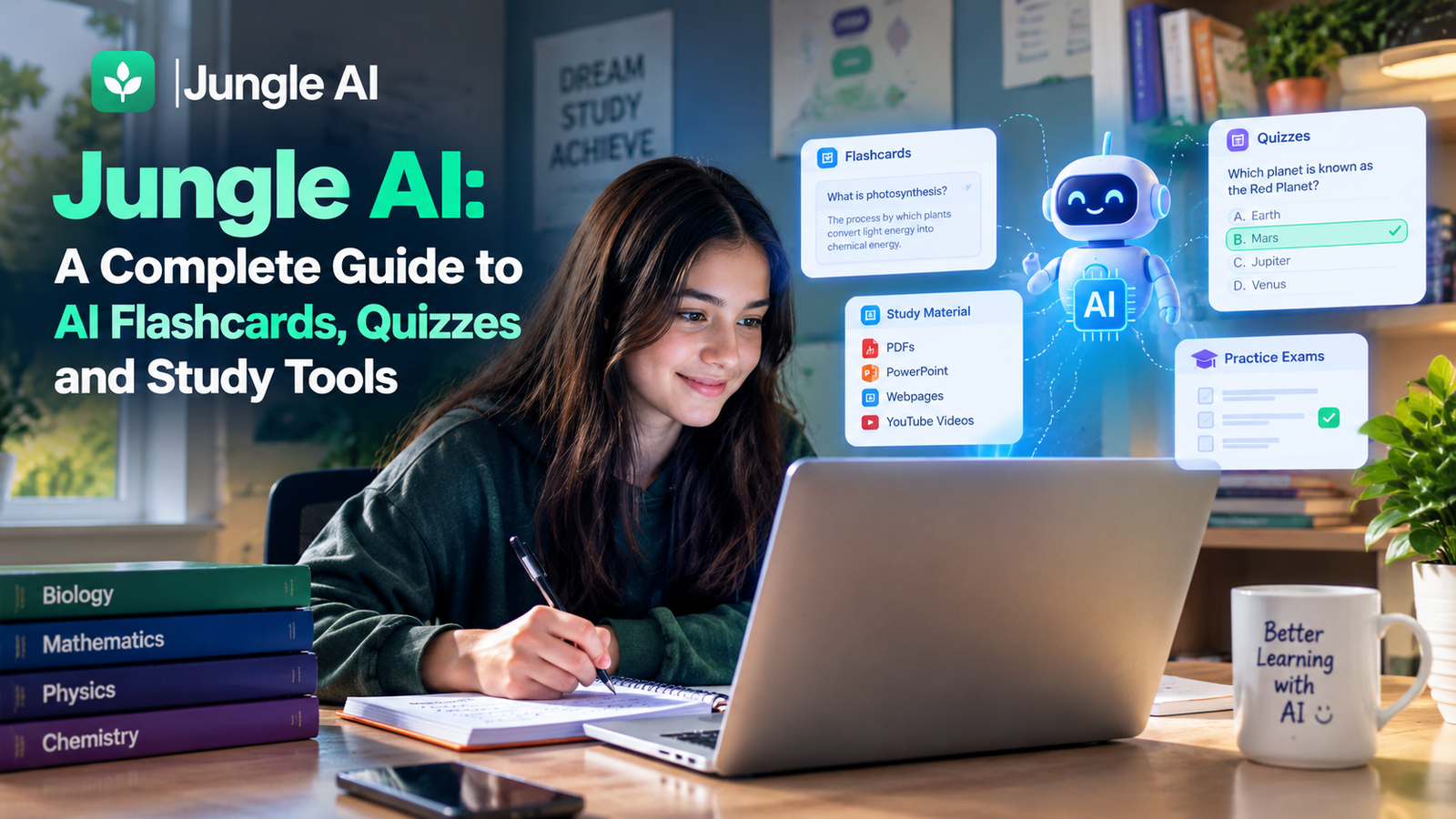

In today’s digital world, students have more study material than ever before. Lecture slides, PDF files, PowerPoint presentations, online articles, videos, notes, and textbooks can all become part of a student’s learning routine. The problem is that having a lot of information does not always make studying easier. Students still need to understand the material, remember important concepts, practice questions, and prepare for exams. This is where Jungle AI comes into the picture.
Jungle AI is an artificial intelligence study platform designed to make learning faster, more interactive, and more organized. Instead of spending hours manually creating flashcards or practice questions, students can use Jungle AI to turn their existing learning material into useful study resources. The platform can work with materials such as lecture slides, PDFs, webpages, PowerPoint files, notes, textbooks, and YouTube videos. It can then create flashcards, multiple-choice questions, and other forms of practice content. Jungle
The main idea behind Jungle AI is simple. Students already have the information they need, but they may not have enough time to turn that information into effective practice material. Artificial intelligence can help automate that process. Instead of reading the same notes again and again, learners can actively test what they know and identify the areas where they need more practice.
What Is Jungle AI?
Jungle AI is an AI-powered study platform created to help students learn from their own educational material. It uses artificial intelligence to analyze uploaded content and transform it into different types of learning activities.
For example, a student may have a long lecture presentation containing dozens of slides. Reading every slide repeatedly can take a lot of time. With Jungle AI, the student can use the material to generate flashcards and practice questions, making the study process more active.
The platform also supports different types of learning content. Its official use-case information highlights AI-generated multiple-choice questions, quizzes, flashcards, image-occlusion activities, practice exams, and spaced-repetition studying. Jungle
This makes Jungle AI more than a simple flashcard generator. It is designed as a broader AI study platform where students can use their existing material to create personalized practice.
How Jungle AI Works
The basic idea behind Jungle AI is based on transforming passive study material into active learning.
A student can start with material they already have, such as lecture slides, a PDF, notes, a webpage, or a YouTube video. Jungle AI processes the content and identifies important information. It can then create questions and flashcards based on the source material.
This approach can save students from doing repetitive preparation work manually. Creating useful flashcards from a long lecture can take a significant amount of time, especially when a student has several subjects to study. AI can handle much of the initial content transformation so that the learner can focus more on answering questions and understanding difficult concepts.
The platform also supports learning from visual information. Its official use-case page describes an image-occlusion feature that can turn images from study slides into interactive learning material. This can be especially useful for subjects where diagrams, labels, structures, and visual relationships are important. Jungle
Jungle AI Flashcards
One of the most important features associated with Jungle AI is AI-generated flashcards.
Flashcards are popular because they encourage active recall. Instead of simply looking at information, students have to remember an answer before checking whether they are correct. This can make revision more engaging than repeatedly reading the same notes.
Jungle AI can create digital flashcards from educational material. A student does not necessarily need to write every question and answer manually. The AI can identify relevant concepts and turn them into study cards.
For example, if a biology lecture explains different parts of a cell, Jungle AI can create questions around those concepts. A student can then review the cards and check their understanding.
The same approach can work for history, science, medicine, law, languages, business, and many other subjects. The quality of the final cards will depend on the quality and clarity of the original material, so students should still review AI-generated content rather than assuming every generated card is perfect.
Jungle AI Quiz Generator
Another major use of Jungle AI is quiz generation.
Quizzes can help students move beyond simple memorization. When learners answer questions without looking at their notes, they get a better idea of what they actually understand.
Jungle AI can generate multiple-choice questions from study material. Its official website specifically promotes AI-generated multiple-choice questions and quizzes created from lecture materials. Jungle
This can be useful before an exam because students can turn their own course content into practice material. Instead of searching for unrelated questions online, they can practice questions connected to the material they are actually expected to learn.
The platform can also provide feedback while students practice. The Android app description says Jungle can provide immediate feedback after answers and help learners identify gaps in their understanding. Google Play
Jungle AI for Exam Preparation
Exam preparation is one of the strongest use cases for Jungle AI.
Many students struggle because they spend too much time reading and too little time testing themselves. Reading notes is important, but active recall and repeated practice can make revision more useful.
Jungle AI can help students create practice questions from their own material. This allows them to study the same subject from different angles.
A student might first use flashcards to learn important definitions. After that, they can use multiple-choice questions to test recognition and understanding. They can then use more challenging questions to check whether they can apply the concept.
This creates a more active study process. Instead of simply asking, “Did I read this chapter?”, the student can ask, “Can I answer questions about this chapter without looking at my notes?”
That difference is important because recognizing information while reading is not always the same as remembering it during an exam.
Spaced Repetition in Jungle AI
Spaced repetition is another important part of modern digital learning.
The basic idea is that information should be reviewed at appropriate intervals instead of being studied repeatedly in one long session. When a student continues reviewing difficult information over time, it can become easier to remember.
Jungle AI includes spaced-repetition studying as one of its highlighted use cases. The platform can help learners focus on concepts that need more practice rather than treating every flashcard as equally important. Jungle
This can be especially useful for students who have a large amount of material to memorize. Instead of manually deciding what to review every day, an AI-powered system can help organize the process.
However, spaced repetition should not replace understanding. Students should first make sure they understand the meaning of a concept before trying to memorize it repeatedly.
Jungle AI and Active Learning
One reason Jungle AI can be useful is its focus on active learning.
Passive learning happens when students mainly read, watch, or listen. Active learning requires them to interact with the information by answering questions, recalling facts, explaining ideas, or solving problems.
Jungle AI supports active learning by turning source material into questions and flashcards.
Imagine a student has a 50-slide lecture. Reading the slides five times may feel productive, but it does not always reveal which topics the student has actually mastered. A quiz can expose weak areas much faster.
If the student repeatedly gets questions about one concept wrong, that is a signal to return to the original material and study that topic again.
This creates a simple cycle of learning, testing, finding weaknesses, and reviewing.
Jungle AI for Different Subjects
Jungle AI can be useful across many different academic subjects because the platform works with general educational content.
For science students, it can help create questions about definitions, processes, diagrams, formulas, and important concepts.
For history students, it can help turn notes into questions about people, events, dates, causes, and consequences.
For language learners, flashcards can be useful for vocabulary and terminology.
For medical and other professional students, question-based practice can be valuable because these learners often need to remember large amounts of detailed information.
The platform also supports visual study through image-occlusion activities, which can be useful when diagrams and labels are important to understanding the material. Jungle
Jungle AI and YouTube Videos
Modern students do not learn only from textbooks and classroom lectures. YouTube has become an important source of educational information.
Jungle AI supports learning material from YouTube videos. The official platform describes YouTube videos as one of the content types that can be used to generate study resources. Jungle
This can be useful when a student watches a long educational video but wants to test their understanding afterward.
Instead of watching the video again from the beginning, the student can use questions and flashcards to identify whether they remember the important points.
Of course, students should make sure they are using educational content from reliable sources. AI can organize information, but it does not automatically make an unreliable source trustworthy.
Jungle AI and PDF Files
PDF documents are common in schools, colleges, universities, and professional education.
Students often receive lecture notes, research material, study guides, and course documents in PDF format. Turning a large PDF into useful study material manually can be difficult.
Jungle AI can use PDFs as a source for generating learning content. This can help students move from long documents to shorter, interactive practice sessions.
For example, a student could have a large study guide before an exam. Instead of reading the entire document every time, they could create flashcards and questions from it and use those resources for revision.
This does not mean the original PDF becomes unnecessary. The original material should remain the main source for detailed understanding, while the generated questions can support practice and revision.
Jungle AI for PowerPoint Presentations
PowerPoint presentations are another common source of educational information.
Teachers and professors often use slide decks to explain lessons. These presentations may contain definitions, diagrams, examples, and important points.
Jungle AI supports PowerPoint material as a source for generating study content. The platform’s official pages specifically mention lecture slide decks and PowerPoint among supported study materials. Jungle
This can be helpful because students often receive presentations with many slides but do not have enough time to create their own flashcards from every section.
AI can help convert those slides into a more interactive format.
Jungle AI Image Occlusion
Image occlusion is an interesting feature for students who learn through diagrams.
A diagram may contain labels that students need to memorize. Instead of simply looking at the labeled diagram, image occlusion can hide certain labels and ask the learner to identify what belongs in that location.
Jungle AI highlights AI image occlusion as one of its use cases. Jungle
This type of learning can be useful in subjects such as biology, anatomy, geography, engineering, and other areas where visual structures matter.
The advantage is that the student is not only reading the label but actively trying to remember its position and meaning.
Jungle AI for Teachers
Although Jungle AI is strongly focused on students, AI study tools can also be useful for teachers.
Teachers can use AI-generated questions as a starting point for classroom review activities. They may also create practice material based on course content and adjust it before giving it to students.
However, teacher review remains important. AI-generated questions should be checked for accuracy, clarity, and suitability for the students’ level.
A teacher can use AI as an assistant rather than treating it as a complete replacement for professional judgment.
Benefits of Jungle AI
The biggest benefit of Jungle AI is time savings.
Creating flashcards manually can take a long time, especially when students are working with large lecture notes. AI can speed up the first stage of that process.
Another benefit is convenience. Students can work with different types of educational material instead of manually copying information into a separate flashcard system.
Jungle AI can also make revision more interactive. Flashcards and quizzes require students to participate instead of simply reading.
The platform’s combination of question generation, feedback, and spaced repetition can also help students create a more structured study routine. Google Play
Limitations of Jungle AI
Even though Jungle AI can be useful, it should not be treated as a perfect replacement for teachers, textbooks, or careful studying.
Artificial intelligence can sometimes misunderstand information or create a question that does not accurately represent the source material. Students should therefore review important generated content, especially when preparing for high-stakes exams.
Another limitation is that simply generating thousands of flashcards does not guarantee better learning. Students still need to think, understand concepts, practice problems, and connect ideas.
There is also a difference between memorizing an answer and understanding why that answer is correct.
The best approach is to use Jungle AI as a study assistant. Students can combine it with lectures, textbooks, teacher explanations, practice problems, and their own notes.
Is Jungle AI Easy to Use?
Jungle AI is designed around a simple workflow.
A student starts with existing learning material and uses it to create practice content. The platform then provides interactive resources such as flashcards and questions.
This can be easier than building an entire study system from scratch.
The official platform promotes a workflow where students upload or provide learning material and begin generating study questions quickly. Jungle
For students who are already comfortable using websites and digital learning applications, the basic idea should feel familiar.
Jungle AI vs Traditional Flashcards
Traditional flashcards require students to create questions and answers manually.
This method can still be excellent because writing your own questions forces you to think carefully about the material. However, it can also take a lot of time.
Jungle AI focuses on reducing that preparation time through artificial intelligence.
The trade-off is that manually created cards may be more personalized, while AI-generated cards are faster to produce. A strong study routine can combine both approaches.
Students can use Jungle AI to create an initial set of cards and then edit or improve the most important ones.
Jungle AI vs Reading Notes Again
Reading notes again can create a feeling of familiarity. Students may look at a concept and think, “I know this,” because it looks familiar.
But an exam does not show you the answer before asking the question.
This is why active recall can be valuable.
Jungle AI can help students move from reading to answering. When a question appears, the student has to retrieve the information from memory.
That process can reveal gaps that are not obvious during normal reading.
Privacy and Responsible AI Use
Students should always think about privacy when uploading educational material to an online AI platform.
Course notes may contain personal information, private classroom content, copyrighted material, or other information that should not be shared publicly.
Before uploading anything, users should understand the platform’s current privacy terms and avoid submitting sensitive information unnecessarily.
Students should also follow their school’s rules about AI use. Some institutions allow AI for study and revision, while others may have restrictions on assignments or examinations.
Using Jungle AI as a study assistant is different from using AI to complete an assignment dishonestly.
How to Use Jungle AI Effectively
The best results usually come from using the platform as part of a wider study routine.
Start with good source material. If the original notes are confusing or incomplete, AI-generated questions may also be less useful.
After generating flashcards or quizzes, answer the questions without immediately checking the answer.
Mark difficult concepts mentally or through the platform’s available learning tools.
Return to the original material when you make mistakes.
Use spaced repetition for information that needs long-term memorization.
Most importantly, do not measure studying only by the number of questions completed. Understanding is more important than simply finishing a large quiz.
Who Should Use Jungle AI?
Jungle AI can be particularly useful for students who have a large amount of digital study material.
University students may use it for lecture slides and course documents. High school students can use it for revision and practice. Professional students can use it to create question-based study sessions from detailed material.
It can also help students who struggle with organizing their revision.
However, students who prefer writing every flashcard themselves may still prefer a traditional method. The best study tool is the one that supports a learner’s actual habits and goals.
Is Jungle AI Worth Using?
For students who regularly work with digital learning material, Jungle AI can be a useful addition to a study routine.
Its biggest advantage is the ability to transform existing content into interactive study resources. The combination of flashcards, quizzes, practice questions, visual learning tools, and spaced repetition gives students multiple ways to review the same subject. Jungle
It is not a magic solution that can guarantee better grades. Students still need discipline, understanding, practice, and consistent revision.
The real value of Jungle AI is that it can reduce some of the repetitive work involved in preparing study materials.
Students interested in trying the platform can visit Jungle AI to explore its current features and study options.
Final Thoughts on Jungle AI
Jungle AI shows how artificial intelligence can change the way students prepare for exams and learn new information.
Instead of treating AI only as a tool for generating answers, students can use it to create questions, practice active recall, review difficult concepts, and organize their learning.
The platform can turn lecture slides, PDFs, PowerPoint files, webpages, notes, and videos into interactive study resources. Its features include AI-generated flashcards, multiple-choice questions, quizzes, image-occlusion activities, and spaced-repetition learning. Jungle
The most important thing is how the technology is used. Jungle AI works best when it supports real learning rather than replacing it. Students should still read their original material, understand important concepts, check AI-generated information, and ask teachers for clarification when something is unclear.
For learners who want to spend less time creating flashcards and more time practicing, Jungle AI can be a practical AI-powered study companion. As artificial intelligence continues to become part of education, tools like Jungle AI show how technology can make traditional study methods more interactive, personalized, and efficient.
Read More About : jilo viral