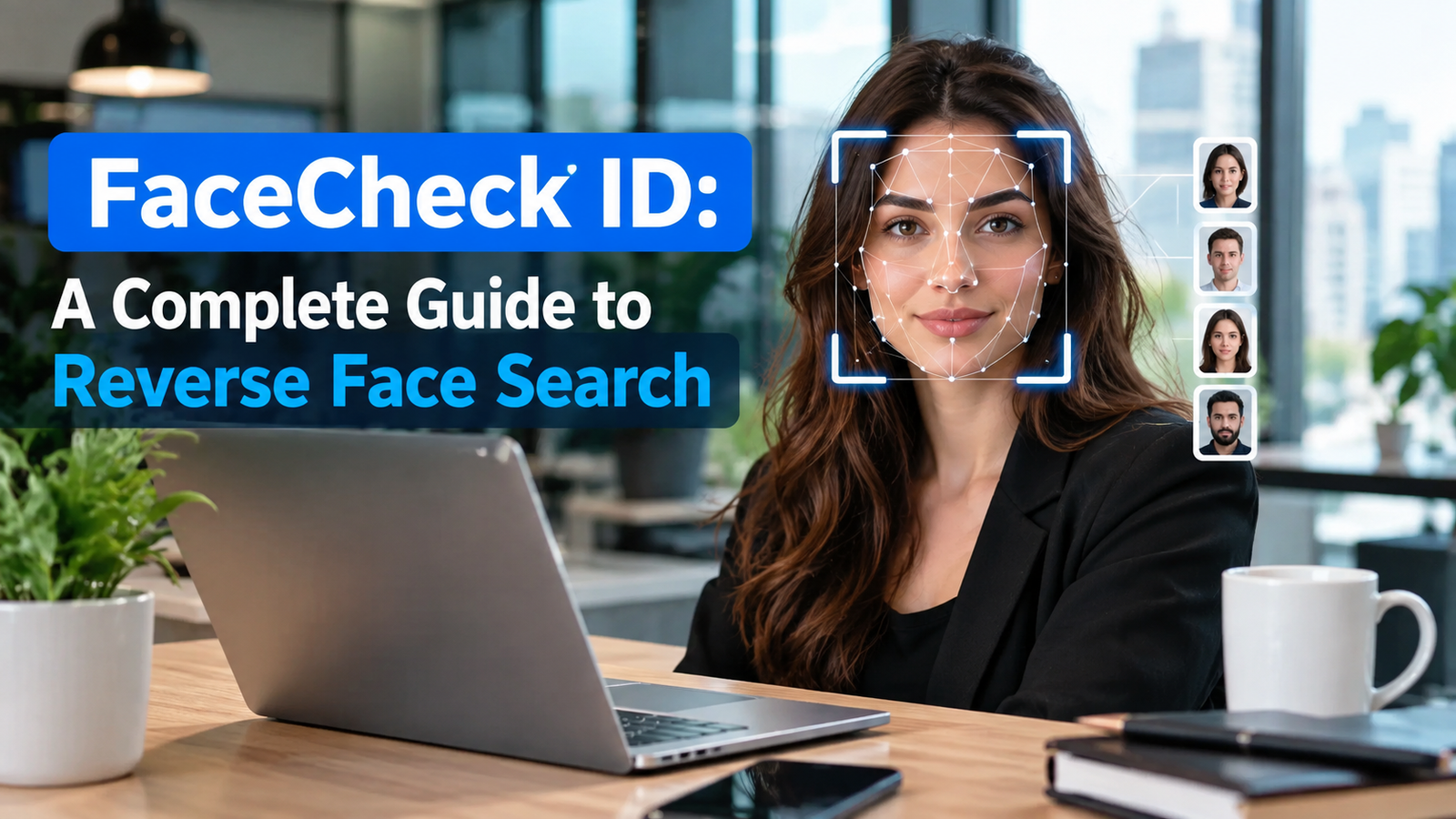

The internet has completely changed the way people search for information. Traditional search engines mainly depend on keywords, names, phrases, and written descriptions, but visual search has introduced another powerful way to discover information. Instead of typing a person’s name or trying to describe a face, users can search with an image. This technology has become especially useful when someone wants to understand where a particular face or photograph appears online.
FaceCheck ID is a platform designed around this concept. It focuses on face-based search, allowing users to upload a photograph and discover webpages where a similar face may appear. This makes FaceCheck ID different from conventional reverse image search services because the technology is focused primarily on the face rather than simply looking for an identical copy of the uploaded image.
People may come across an unfamiliar profile picture, receive a suspicious photograph, discover that their own image is being reused, or simply want to learn whether a particular photo appears elsewhere online. In such situations, FaceCheck ID can provide useful search leads. However, understanding how the technology works and how its results should be interpreted is extremely important.
This complete guide explains what FaceCheck ID is, how FaceCheck ID works, how face search differs from ordinary reverse image search, what affects search quality, how to interpret match scores, and what privacy and ethical considerations users should keep in mind.
What Is FaceCheck ID?
FaceCheck ID is a face-search engine that allows users to search the public web using a photograph containing a face. Instead of requiring the user to know a person’s name, username, website, or other identifying information, the service starts with the visual characteristics of a face.
When a user submits an image, the system analyzes the visible face and looks for visually similar faces within its indexed collection. The results can lead to webpages where similar facial appearances have been found. According to the platform’s own explanation, FaceCheck focuses on finding webpages containing the same or similar face rather than providing a guaranteed identity confirmation.
This distinction is important because a face search result should not automatically be interpreted as proof that two online profiles belong to the same individual. Facial similarity can provide an important lead, but additional information and human judgment are necessary before reaching a conclusion.
The concept behind FaceCheck ID is particularly useful because people frequently reuse photographs across different websites. A profile picture may appear on a social network, an online article, a personal website, a public profile, or another webpage. Traditional searches can sometimes fail to connect these appearances when the images have been resized, cropped, edited, or photographed under different conditions.
FaceCheck ID attempts to solve part of this problem by focusing on the face itself.
How Does FaceCheck ID Work?
Understanding how FaceCheck ID works makes it easier to understand both its advantages and its limitations. Face search generally begins when a user uploads a photograph containing a recognizable face.
The system first needs to detect the face within the image. If there are multiple people in the photograph, the technology has to determine which facial region can be analyzed. The face is then processed so that important visual characteristics can be compared with faces available in the search index.
Modern face-search technology commonly represents facial characteristics using numerical data known as a face embedding or visual representation. Instead of comparing every pixel of two photographs, the system compares characteristics associated with the facial structure. This allows two photographs of the same person to potentially produce a match even when the background, clothing, lighting, image size, or camera angle is different.
After processing the uploaded image, FaceCheck ID compares the facial representation against faces found on publicly accessible webpages. Potential matches are then presented to the user along with information that can help them investigate the corresponding pages.
The result is therefore better understood as a visual search process rather than a traditional identity database. FaceCheck ID itself explains that its results point users toward webpages where similar faces have appeared and that the service should not be treated as a guaranteed identity verification system.
FaceCheck ID and Reverse Image Search
FaceCheck ID is often discussed alongside reverse image search tools, but the two concepts are not exactly the same.
Traditional reverse image search usually attempts to locate the same image or visually similar copies of an image. If someone uploads a photograph, the system may look for webpages containing that exact photograph or versions that are sufficiently similar.
Face search takes a different approach. Instead of concentrating primarily on the complete photograph, face search concentrates on the facial characteristics visible within the photograph.
For example, imagine that a person has a profile picture that appears on one website. Another website might contain a different photograph of the same person taken several months later. The background could be completely different, the clothing could have changed, and the photograph could have been taken from another angle. A traditional image search may have difficulty connecting the two photographs because they are not copies of the same image.
A face-search system can potentially identify a relationship because the facial features remain sufficiently similar.
This makes FaceCheck ID particularly interesting for situations where a user has a photograph but does not know whether the same face appears in other online locations.
Why People Use FaceCheck ID
There are many legitimate reasons someone may be interested in FaceCheck ID. One common reason is online safety. People sometimes communicate with strangers through dating platforms, social networks, marketplaces, and messaging services. A profile photograph may not always represent the person operating the account.
A face search can sometimes reveal that a profile photograph has appeared elsewhere online. If the same photograph is associated with completely different names or profiles, that information can be a useful warning sign that deserves further investigation.
Another use case involves protecting personal images. Someone may discover that their photograph is being used on an unfamiliar website or profile without permission. Searching for the face can potentially help locate other public appearances of the image.
FaceCheck ID can also be useful for open-source research. Researchers may have a photograph but lack a name or other information. A face search can provide webpages that serve as starting points for additional research.
Journalists, researchers, online safety professionals, and ordinary internet users may all find visual search useful in appropriate circumstances. However, responsible use is essential because facial information can be sensitive and results can sometimes be misleading.
FaceCheck ID for Online Safety
Online scams have become increasingly sophisticated. Fraudulent accounts can use photographs belonging to real people, professional-looking images, or photographs taken from public profiles. This can make it difficult for an ordinary user to determine whether an online identity is genuine.
FaceCheck ID can provide an additional research step when someone wants to investigate a suspicious profile photograph.
For example, suppose an unfamiliar online contact claims to be a professional living in one country, but the same photograph appears on unrelated webpages under different names. That situation does not automatically prove fraud, but it can be an important warning sign.
The safest approach is to combine FaceCheck ID results with other information. Users can examine the context of matching webpages, compare usernames, check dates, review publicly available information, and look for contradictions.
A face-search result should therefore be treated as a clue rather than a final answer.
Understanding FaceCheck ID Match Scores
One of the most important parts of using FaceCheck ID is understanding match scores correctly. A numerical similarity score can look very convincing, but users should not interpret it as a guaranteed percentage probability that two images belong to the same person.
FaceCheck explains that its match quality score represents how closely faces appear to match. Its official FAQ describes different confidence ranges and notes that higher scores generally provide stronger matches when the uploaded photograph clearly shows an unobstructed face.
Even a high score does not eliminate the possibility of a false match. People can naturally look very similar, especially when photographs have limited detail or when the subjects have similar facial structures.
For this reason, a user should consider the complete context of a result instead of focusing only on the number.
If several independent webpages contain photographs of the same person and those pages also contain consistent names, dates, professional information, or other relevant context, the overall evidence can become more meaningful.
A single high-scoring result with no supporting information should be treated more carefully.
What Makes a Good FaceCheck ID Search?
The quality of the uploaded photograph can have a major influence on search results. A clear photograph where the face is visible usually provides better information for facial analysis.
Images with strong lighting can make facial features easier to analyze. A front-facing photograph can also be more useful than an image where the person is looking sharply to one side.
Heavy filters, extreme compression, motion blur, sunglasses, masks, and other forms of obstruction can reduce the amount of useful facial information available to the system.
The difference between a high-quality photograph and a poor-quality photograph can therefore be significant. A blurry screenshot may produce weak or confusing results, while a clear portrait may provide more useful matches.
FaceCheck’s own guidance similarly notes that unobstructed, high-quality facial images generally produce more reliable results.
Users should also remember that the search index matters. If a person’s photographs are not publicly available or have not been indexed, a face-search service may have little information to return.
Why FaceCheck ID Results Can Be Wrong
No face-search technology should be considered perfect. There are several reasons why FaceCheck ID may return an incorrect or unexpected result.
One reason is the natural similarity between different people. Human faces share many common characteristics, and two unrelated individuals can sometimes look remarkably similar.
Image quality is another factor. If a photograph is blurry, heavily edited, poorly illuminated, or partially covered, the system may have difficulty extracting useful facial characteristics.
Age can also affect facial appearance. A photograph taken many years apart may show noticeable changes in hairstyle, facial hair, weight, skin, and other characteristics.
Different camera angles can create another challenge. A front-facing portrait can look very different from a side-profile photograph.
AI-generated or heavily manipulated images can create additional uncertainty. Modern image-editing technology can significantly change facial appearance, which may influence the reliability of visual matching.
Because of these limitations, FaceCheck ID results should be evaluated as search leads rather than absolute proof.
FaceCheck ID and Fake Profiles
Fake profiles are one of the most discussed reasons people use reverse face search. A fraudulent account may use a photograph belonging to another person and create an entirely different online identity around it.
FaceCheck ID can sometimes help users discover whether the same face appears in multiple unrelated contexts.
Suppose a person receives a profile photograph from an unknown contact. A search may reveal that the photograph appears on several websites with different names. This information can indicate that the photograph may have been reused.
However, even this situation requires careful interpretation. A photograph appearing on multiple websites does not automatically mean that every account associated with the image is controlled by the same person.
The person in the photograph and the person operating an online account can be completely different individuals. This is why contextual investigation remains important.
FaceCheck ID and Privacy
Privacy is an important consideration whenever facial search technology is involved. A face is a sensitive form of visual information, and users should think carefully about what images they upload and how they use search results.
FaceCheck states that it does not provide guaranteed identity identification and explains its approach to search data and publicly available information. The service also states that uploaded searches are temporary and that search history is deleted within a specified period. Users should always review the current privacy information and applicable laws in their own jurisdiction before using any facial search service.
For anyone who wants to understand the platform’s current policies and privacy explanations in more detail, the official FaceCheck ID FAQ and support information provides additional information.
Privacy considerations become particularly important when searching for other people. Users should avoid using face-search technology for harassment, stalking, intimidation, unauthorized surveillance, or other harmful activities.
Is FaceCheck ID a Guaranteed Identity Verification Tool?
No. This is one of the most important points to understand about FaceCheck ID.
A face match is not automatically an identity confirmation. The system can identify visual similarities between photographs, but the final interpretation requires human judgment and supporting information.
FaceCheck itself emphasizes that a computer cannot guarantee a person’s identity from low-quality internet photographs and that lookalikes can produce misleading results.
Imagine finding a photograph that looks almost identical to the person you are searching for. That does not automatically prove that the two photographs show the same individual.
A responsible investigation should consider the source webpage, publication date, surrounding text, usernames, professional information, and other independent evidence.
This approach reduces the risk of making a serious mistake based solely on facial similarity.
FaceCheck ID for Finding Your Own Photos
FaceCheck ID can also be useful for people who want to understand where their own face appears publicly online.
Photographs can travel across the internet without the original photographer or subject realizing it. A public image may be copied into another profile, article, forum, or website.
Searching for your own face can potentially help you discover public appearances that you were not aware of.
This can be particularly relevant for photographers, creators, public speakers, professionals, influencers, and people who maintain a visible online presence.
If someone discovers unauthorized use of their image, they can investigate the webpage and determine what action may be appropriate. Depending on the circumstances, that could involve contacting the website owner, requesting removal, reporting the profile, or pursuing another legitimate remedy.
FaceCheck ID for Researchers
Visual search can be valuable in open-source research because researchers sometimes begin with incomplete information.
A photograph may provide the first clue, while the name, website, location, and other contextual information remain unknown.
FaceCheck ID can potentially help researchers locate publicly available webpages where similar faces have appeared. Those webpages may then provide additional clues that can be independently verified.
Responsible researchers should maintain a clear distinction between a search result and a verified fact. A facial match can point toward a source, but the source itself should be examined carefully.
This approach is especially important when research involves sensitive topics or people who could be harmed by an incorrect identification.
FaceCheck ID and Ethical Use
Technology does not determine whether an activity is ethical; the way people use technology matters.
FaceCheck ID can be helpful when someone is protecting their own images, investigating potential online fraud, checking public information, or conducting legitimate research.
At the same time, using facial search to target private individuals, spread accusations, invade someone’s privacy, or encourage harassment can cause serious harm.
A responsible user should always ask whether a search is necessary, whether the information is publicly available, and whether the intended use could negatively affect another person.
It is also important to respect local laws. Facial recognition and biometric technologies are regulated differently across countries and jurisdictions. What is permitted in one location may be restricted in another.
FaceCheck ID Compared With Traditional Search
Traditional search engines are excellent when the user knows a name, phrase, topic, or keyword. But they are less useful when the only available information is a photograph.
FaceCheck ID changes the starting point from text to a face.
This can make visual discovery more practical when a user does not know the person’s name or when the available information is incomplete.
Traditional reverse image search and FaceCheck ID can also complement each other. A user might first search the complete image and then use a face-based search to discover different photographs of the same face.
Using more than one research method can provide a broader picture, although every result still needs to be evaluated independently.
The Importance of Context in FaceCheck ID Results
Context is arguably more important than the match score itself.
Suppose a face-search result leads to a webpage with the same person but the surrounding information contradicts what the user expected. That contradiction should not be ignored.
On the other hand, if multiple independent websites contain photographs of the same face and consistent information, the combined evidence can become stronger.
Dates can also be useful. If a photograph appears online years before a newly created profile, that may help explain where the image originated.
Usernames, captions, professional biographies, publication details, and other publicly available information can provide additional context.
The goal should therefore be to use FaceCheck ID as the beginning of research rather than the end of it.
Benefits of FaceCheck ID
The biggest advantage of FaceCheck ID is that it allows users to search using a face rather than depending entirely on keywords.
This can be especially useful when a user does not know a person’s name or when a photograph has been reused in different forms.
Another advantage is that face search can potentially connect different photographs of the same person even when the photographs are not exact copies.
FaceCheck ID can also provide useful leads for online safety investigations, image reuse checks, and open-source research.
For people concerned about their own online presence, a face search can offer another way to understand where their photographs may appear publicly.
Limitations of FaceCheck ID
Despite its usefulness, FaceCheck ID has important limitations.
It cannot guarantee that every search result represents the same person. Similar-looking people can create false positives, while poor-quality photographs can create false negatives.
The service also depends on publicly available information. A photograph that does not exist on indexed public webpages may not produce useful results.
Search results can also change over time as webpages are added, removed, updated, or reindexed.
Most importantly, users should not treat FaceCheck ID as a government identity database or a definitive identity verification system. It is a visual search technology that can help users discover online information.
How to Use FaceCheck ID Responsibly
Responsible use begins with having a legitimate reason for conducting a search.
If you are checking whether your own photograph is being reused, face search can be a useful research method. If you are investigating a suspicious online profile, the results can serve as an additional warning signal.
The safest approach is to avoid making immediate accusations. Instead, review the source pages and compare multiple independent pieces of information.
Users should also avoid sharing sensitive search results unnecessarily. If a result concerns another person, publishing or distributing it could create privacy or reputational problems.
The best use of FaceCheck ID is therefore evidence-oriented rather than accusation-oriented.
Final Thoughts on FaceCheck ID
FaceCheck ID represents an important development in visual search technology because it allows people to search the web through facial appearance rather than relying only on words.
Its ability to locate webpages containing similar faces can be useful for online safety, image monitoring, open-source research, and discovering how photographs are being reused online.
At the same time, FaceCheck ID should be used with realistic expectations. A facial similarity result is not the same thing as confirmed identity. Image quality, facial similarity, changes in appearance, limited web indexing, and other technical factors can influence search results.
The most reliable approach is to treat FaceCheck ID as a research tool that generates leads. Users should examine the webpages behind those leads, compare supporting information, consider alternative explanations, and avoid making serious conclusions based on a single match.
Privacy and ethics should also remain central to any face-search activity. Searching for your own images or investigating potential online fraud can be legitimate and useful, while harmful activities such as stalking, harassment, or unauthorized identification should be avoided.
As visual search technology continues to develop, tools such as FaceCheck ID are likely to become increasingly relevant to the way people discover information online. The real value of the technology comes not simply from finding a similar face, but from helping users connect visual information with reliable context and make better-informed decisions.
Read More About : wallpostmedia com