
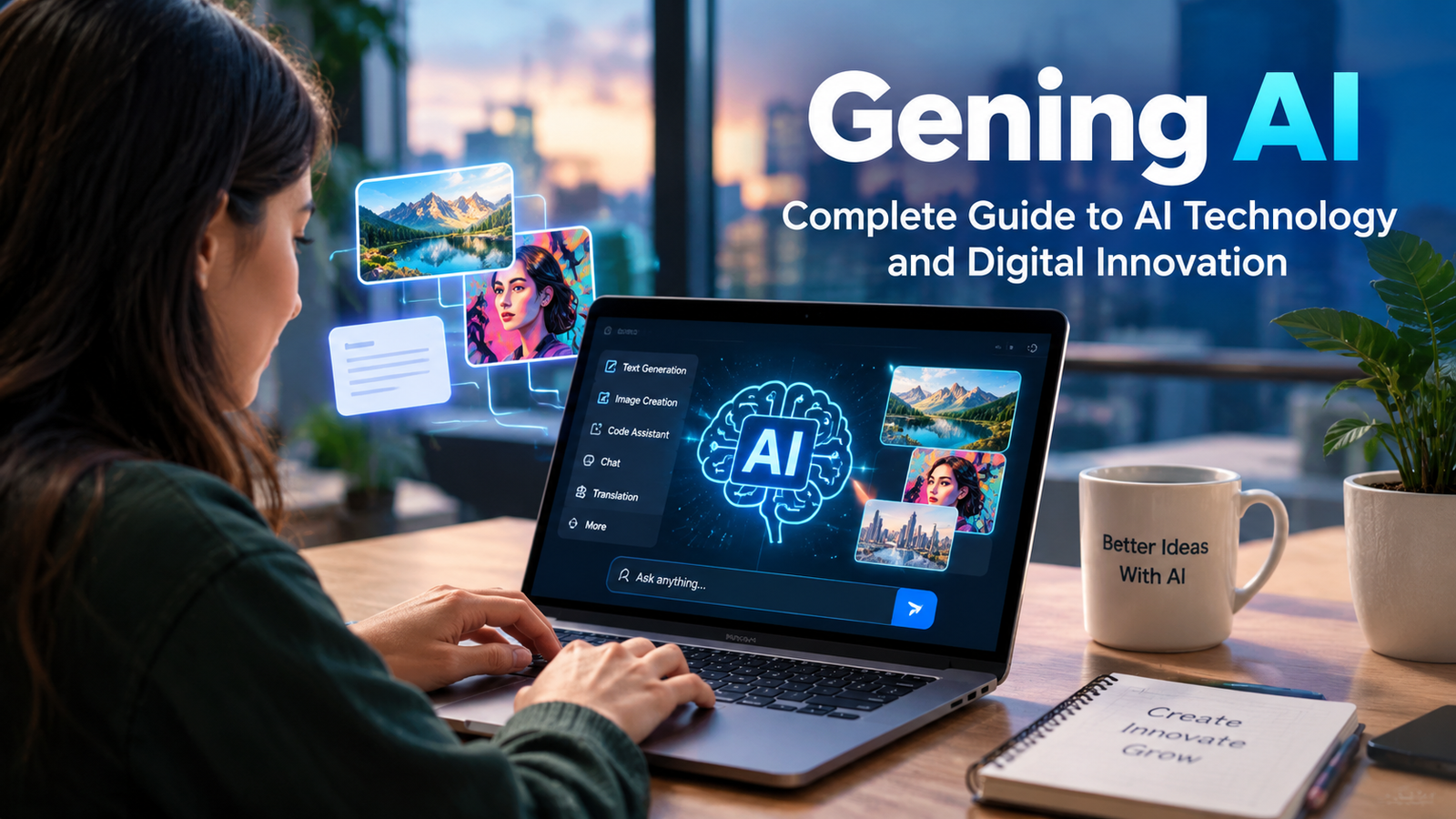

Artificial intelligence is changing the way people create, work, communicate, and solve everyday problems. From generating images and writing content to helping businesses automate tasks, AI technology has become an important part of the modern digital world. Among the growing number of AI-focused platforms and tools, Gening AI is a name that attracts attention because of its connection with artificial intelligence, digital creativity, automation, and modern online experiences.
The growing interest in Gening AI reflects a much bigger trend in technology. People are no longer using computers only for traditional tasks. They are looking for intelligent systems that can understand instructions, generate useful results, support creative work, and reduce the time required to complete different activities. AI platforms are becoming easier to use, which means that even beginners can explore powerful technologies without having advanced technical knowledge.
For students, creators, marketers, developers, business owners, and everyday internet users, understanding AI platforms can be useful. Gening AI can be discussed in the wider context of generative artificial intelligence, where computer systems can produce new content based on user instructions. This content may include text, images, ideas, designs, summaries, or other digital outputs depending on the technology being used.
This guide explores Gening AI, its possible role in modern artificial intelligence, important features to understand, potential benefits, practical uses, limitations, safety considerations, and the future of AI-powered creativity. The goal is to provide a clear and useful overview for readers who want to understand this growing technology area.
What Is Gening AI?
Gening AI can be understood within the growing ecosystem of artificial intelligence and generative AI technologies. Generative AI refers to systems that can create new content after receiving instructions from a user. Instead of simply displaying information that already exists, generative systems can process an instruction and produce an original response based on patterns learned from large amounts of data.
The concept behind Gening AI is connected to the broader movement toward intelligent digital tools. Modern AI systems can understand natural language, recognize patterns, analyze information, and assist users with creative and practical tasks. These capabilities are making AI more accessible to people who may not have programming or technical backgrounds.
The word “generative” is especially important when discussing modern AI. Traditional software usually follows predefined commands and produces predictable outputs. Generative AI can work differently because it can create results dynamically according to the user’s request. This makes it useful for creative projects, research, communication, education, and many professional activities.
As AI continues to develop, platforms associated with Gening AI and similar technologies may become increasingly important in the digital environment.
How Gening AI Fits Into Artificial Intelligence
Artificial intelligence is a broad field that includes machine learning, natural language processing, computer vision, automation, predictive systems, and generative technologies. Gening AI belongs to a technology environment where intelligent systems are designed to help users complete tasks more efficiently.
Machine learning allows computers to identify patterns from data. Natural language processing helps systems understand human language. Computer vision allows AI models to interpret visual information. Generative AI takes these capabilities further by allowing systems to create new digital content.
For example, a user could provide a written instruction describing an image they want to create. An AI model can analyze the words, understand the requested objects and style, and then generate a visual result. A similar process can happen with text, where a user provides a topic and the AI generates an explanation, article, summary, or creative concept.
This type of technology explains why AI platforms are becoming valuable across many industries. Instead of requiring separate tools for every small task, users increasingly want intelligent systems that can support multiple parts of their workflow.
Why Gening AI Is Getting Attention
The popularity of AI is growing because people want faster and smarter ways to complete digital tasks. Creating content manually can take a significant amount of time. Designing graphics, researching topics, writing drafts, editing text, and organizing ideas can all require considerable effort.
Gening AI represents the type of technology that can potentially simplify these processes. AI-powered tools can help users generate initial ideas, explore creative directions, and complete repetitive tasks more efficiently.
Another reason AI platforms are receiving attention is accessibility. In the past, advanced digital tools were often difficult for beginners because they required technical training. Modern AI interfaces are increasingly based on natural language, allowing users to communicate with systems in a conversational way.
This means that someone can describe what they need instead of learning a complicated set of commands. The easier AI becomes to use, the more people are likely to experiment with it.
Main Concept Behind Gening AI
The central idea behind Gening AI can be connected to intelligent content generation and digital assistance. AI models are trained using large datasets and learn patterns that help them generate useful outputs.
When a user provides an instruction, the system processes the information and attempts to produce an appropriate result. The quality of that result depends on several factors, including the underlying model, training data, user instructions, system design, and the complexity of the task.
This is why prompts are important when working with generative AI. A clear instruction can give an AI system better information about what the user expects.
For example, instead of asking an AI system to “make an image,” a user could explain the subject, environment, lighting, style, composition, mood, and desired quality. More specific instructions can help the system understand the creative goal more accurately.
Gening AI and Content Creation
Content creation is one of the most important areas where artificial intelligence is having an impact. Writers, bloggers, marketers, social media creators, and businesses can use AI tools to support their content workflows.
Gening AI can be considered part of this larger AI content ecosystem. Generative technologies can assist with brainstorming, outlines, drafts, rewriting, summaries, descriptions, and other content-related activities.
For bloggers, AI can help generate ideas for articles and organize information into logical sections. For marketers, AI can assist with campaign concepts and promotional copy. Social media creators can use AI to explore caption ideas and creative themes.
However, AI-generated content should not automatically be published without review. Human editing remains important because AI can sometimes produce inaccurate information, repetitive wording, unnatural statements, or claims that require verification.
The strongest approach is often to use AI as an assistant rather than treating it as a complete replacement for human creativity.
Gening AI for Image Generation
AI image generation has become one of the most visible applications of generative artificial intelligence. Modern systems can create visuals from written descriptions, allowing users to turn ideas into images without traditional graphic design skills.
This technology can be useful for websites, blogs, social media, advertising concepts, educational materials, presentations, and creative projects.
A user can describe a scene in natural language and an AI image system can attempt to transform that description into a visual composition. The result can depend heavily on the quality of the prompt.
For example, a detailed prompt could describe a modern office where a person is using an AI assistant on a computer, with realistic lighting, professional surroundings, and a clean composition. Such instructions provide more information than a simple request for an “AI image.”
This development is changing the relationship between technology and creativity. People who previously needed advanced design software can now experiment with visual ideas using natural language.
Gening AI for Writing
Text generation is another major area of artificial intelligence. AI language models can understand prompts and produce written responses across many subjects.
Gening AI can be considered within this broader movement toward AI-assisted writing. Writers can use intelligent tools for brainstorming, drafting, summarizing, rewriting, proofreading, and organizing ideas.
Students can use AI to understand difficult concepts when it is used responsibly. Businesses can use it to prepare drafts of emails, reports, descriptions, and internal documents. Website owners can use AI to brainstorm content topics and improve readability.
However, users should always check AI-generated information before relying on it. AI systems can make mistakes, especially when dealing with highly specific, changing, or specialized information.
Human judgment remains essential.
Gening AI and Productivity
One of the biggest benefits of artificial intelligence is improved productivity. Many digital tasks are repetitive and time-consuming. AI can help users handle parts of these processes more efficiently.
For example, AI can summarize long information, organize ideas, generate draft text, classify information, and assist with routine communication. This can give users more time to focus on tasks requiring human judgment and creativity.
For professionals, productivity improvements can be especially valuable. Instead of spending hours preparing a basic first draft, a person may use AI to create a starting point and then spend more time improving the final result.
The important point is that productivity does not simply mean doing everything faster. Good productivity means using technology to reduce unnecessary work while maintaining quality.
Gening AI for Businesses
Businesses are increasingly exploring artificial intelligence because AI can support many parts of their operations. Customer support, marketing, data analysis, content creation, research, and workflow automation are just a few examples.
Gening AI fits into a broader technology environment where businesses can explore AI-assisted processes. A small business may use AI to generate marketing ideas, while a larger organization may use advanced AI systems for customer service or internal automation.
AI can also help businesses understand customer questions and identify common patterns in feedback. When used correctly, these capabilities can improve efficiency and help organizations make better decisions.
However, businesses should carefully consider privacy, data security, accuracy, and compliance before using AI with sensitive information.
Gening AI and Education
Education is another area where artificial intelligence can provide valuable support. Students can use AI tools to explore difficult subjects, request explanations, practice writing, and organize study materials.
Teachers can also explore AI for lesson planning, educational activities, summaries, and classroom resources.
The key is responsible use. Students should use AI to improve their understanding rather than simply copying answers. Learning becomes more valuable when technology helps a student understand why an answer is correct.
AI can act like a digital learning assistant, but it should not replace independent thinking. Students still need to develop research skills, creativity, communication abilities, and problem-solving skills.
The Importance of Good Prompts
Prompt writing is becoming an important skill in the age of generative AI. A prompt is the instruction given to an AI system.
The quality of the prompt can strongly influence the quality of the result. A vague prompt may produce a general answer, while a detailed prompt can provide more useful direction.
A strong prompt usually explains the goal, context, desired format, audience, tone, and important requirements. When generating images, it can also describe composition, environment, lighting, realism, subject, and style.
For Gening AI and similar AI technologies, learning how to communicate clearly with AI can help users get better results.
Prompt skills are becoming similar to other digital skills. As AI becomes more common, people who understand how to communicate effectively with AI systems may have an advantage.
Gening AI and Human Creativity
Some people worry that AI will replace human creativity. However, artificial intelligence can also become a tool that expands creative possibilities.
Human creativity comes from experience, emotions, imagination, culture, personal knowledge, and individual perspectives. AI systems process patterns and generate outputs based on their training and instructions.
When humans and AI work together, the result can be more powerful than either approach alone. A person can provide the idea, direction, judgment, and emotional context while AI can help with rapid experimentation.
For example, a designer may use AI to explore multiple visual concepts before choosing one to develop further. A writer may use AI to brainstorm ideas but then rewrite the final article using personal knowledge and research.
This human-AI collaboration is likely to become increasingly important.
Benefits of Gening AI
The potential benefits of Gening AI and similar artificial intelligence technologies are broad. One major advantage is speed. AI can generate drafts and ideas much faster than many traditional workflows.
Another benefit is accessibility. People without advanced technical skills can experiment with AI-powered tools using natural language.
AI can also support creativity by giving users new ideas and alternative approaches. Instead of starting with a completely blank page, users can begin with an AI-generated concept and improve it.
Automation is another important benefit. Repetitive tasks can sometimes be assisted or automated, allowing people to focus on more valuable activities.
AI can also support personalization. Intelligent systems can adapt responses according to user instructions, making digital experiences more flexible.
Limitations of Gening AI
Despite its advantages, artificial intelligence has limitations. Users should understand these limitations before relying heavily on AI-generated results.
AI can produce incorrect information. Sometimes an answer may sound confident even when it is not accurate. This is one of the most important reasons why human verification is necessary.
AI can also misunderstand instructions. A prompt may appear clear to a person but still produce an unexpected result because the system interpreted the request differently.
Creative outputs can also vary. An AI-generated image may contain visual problems, unusual details, or inconsistencies. Text may contain repetition or generic language.
Another limitation is that AI does not have human understanding in the same way people do. It processes patterns and information but does not experience the world like a human being.
Understanding these limitations helps users work with AI more effectively.
Privacy and Security Considerations
Privacy is an important issue when using AI-powered platforms. Users should think carefully about what information they provide to an AI system.
Sensitive personal information, private documents, passwords, financial details, and confidential business data should not be shared with an AI service unless the user understands how the platform handles that information.
Security policies can vary between services. Before using an AI platform regularly, users should review its privacy and data policies.
The broader AI industry continues to focus on responsible development, security, and user protection. Users should also take responsibility by avoiding unnecessary exposure of sensitive information.
Gening AI and the Future of Work
Artificial intelligence is changing the workplace. Some tasks that previously required significant manual effort can now be supported by AI.
This does not necessarily mean that every job will disappear. Instead, many jobs may change as AI becomes part of everyday workflows.
Workers may need to learn how to use AI tools effectively. Communication, critical thinking, creativity, leadership, and problem-solving are likely to remain important because these skills help people make decisions and use technology responsibly.
AI literacy may become as important as other digital skills. Understanding how AI works, what it can do, and where it can fail can help workers adapt to changing environments.
Gening AI and Digital Transformation
Digital transformation is the process of using technology to improve how organizations operate. Artificial intelligence is becoming an important part of this transformation.
Companies can use AI to improve workflows, automate repetitive activities, analyze information, and create better digital experiences.
Gening AI represents the type of AI-focused technology that fits into this larger transformation. As intelligent tools become easier to access, businesses of different sizes can experiment with AI without necessarily building complex systems from the ground up.
The future of digital transformation will likely involve stronger cooperation between humans, software, automation, and AI.
How to Use AI Responsibly
Responsible AI use begins with understanding that technology is a tool. Users should not assume that every AI-generated result is automatically correct.
Information should be reviewed before publication or use, especially when it relates to education, business, law, finance, health, or other sensitive areas.
Users should also respect copyright, privacy, and intellectual property. AI should be used to support creativity rather than to deliberately copy another person’s work.
Transparency can also be important. In professional or educational environments, users may need to disclose when AI has played a significant role in creating content.
Responsible use allows people to benefit from AI while reducing unnecessary risks.
Gening AI and the Changing Internet
The internet is becoming more intelligent as AI-powered services become integrated into search engines, websites, applications, creative tools, and communication platforms.
Users can increasingly interact with software using natural language instead of traditional menus and commands. This shift is changing how people search for information and complete digital tasks.
AI-powered search and recommendation systems can provide more personalized experiences. Generative systems can also create content based on user requests.
For website owners and content creators, this means that quality and usefulness are becoming increasingly important. Simply creating large amounts of content is not enough. Content should provide genuine value, accurate information, clear explanations, and a good user experience.
Semantic Optimization and Gening AI
Semantic SEO is especially relevant when creating content around AI topics. Search engines increasingly understand the relationships between words, concepts, entities, and user intent.
An article about Gening AI should therefore not repeat the keyword unnaturally. It should also discuss related concepts such as artificial intelligence, generative AI, machine learning, AI tools, automation, content generation, AI creativity, digital transformation, AI productivity, and responsible AI.
This creates a stronger topical relationship around the main keyword.
Natural keyword usage is more effective than excessive repetition. The focus keyword should appear in important locations such as the title, introduction, relevant headings, and body content, while related terms should provide additional context.
This approach helps create content that is useful for both readers and search engines.
Why Natural Keyword Density Matters
Keyword density is still useful as a basic SEO consideration, but it should not become the main goal of an article. Excessive repetition can make content difficult to read and may appear unnatural.
For Gening AI, the keyword should be used naturally throughout the article. Related terms can help strengthen the topic without forcing the exact phrase into every paragraph.
A high-quality article should sound natural when read by a human. If removing a repeated keyword makes a sentence clearer, readability should usually come first.
SEO works best when optimization and usefulness are balanced.
The Future of Gening AI
The future of AI is likely to involve more powerful models, better personalization, improved multimodal capabilities, and deeper integration with everyday software.
AI systems may become better at understanding text, images, audio, video, and other forms of information together. This could create more advanced digital assistants capable of handling complex workflows.
Gening AI and similar technologies may continue to evolve as the AI industry develops. Future platforms could offer more personalized creative tools, smarter automation, better content generation, and improved user experiences.
At the same time, AI development will need to address important challenges involving privacy, misinformation, security, copyright, bias, and responsible use.
The future of AI will therefore depend not only on technical progress but also on how society chooses to use that technology.
Gening AI for Everyday Users
AI is no longer limited to large technology companies or professional developers. Everyday internet users can now access AI-powered tools for many simple activities.
Someone might use AI to generate ideas for a school project. Another person might use it to improve an email or understand a complicated topic. A content creator might use AI to brainstorm a video concept, while a small business owner might use it to prepare marketing ideas.
This accessibility is one of the most important developments in modern technology.
As platforms become easier to use, the main skill may shift from knowing how to operate complicated software to knowing how to clearly explain what you want technology to accomplish.
Gening AI and Innovation
Innovation often happens when technology makes previously difficult tasks easier. Artificial intelligence is creating new possibilities by allowing people to experiment quickly.
A creator can test different ideas without spending hours developing every concept manually. A business can explore multiple marketing approaches. A student can ask for different explanations of the same topic.
This ability to experiment can encourage innovation.
The most successful users will likely be those who combine AI capabilities with human judgment rather than depending entirely on automated outputs.
Conclusion
Gening AI represents the growing interest in artificial intelligence, generative technology, automation, and digital creativity. As AI becomes more accessible, people are finding new ways to use intelligent systems for writing, images, productivity, education, business, research, and creative work.
The biggest advantage of AI is not simply that it can generate content quickly. Its greater value comes from helping people explore ideas, reduce repetitive work, improve productivity, and experiment with new possibilities.
At the same time, users should understand the limitations of AI. Generated information can contain errors, creative outputs may require editing, and privacy should always be considered when sharing information with an AI system.
The future of Gening AI and the wider artificial intelligence industry is likely to be shaped by a combination of technological innovation and responsible human use. People who learn how to communicate effectively with AI, verify its results, and combine its capabilities with their own creativity can make better use of this technology.
Artificial intelligence is not simply a trend. It is becoming an important part of the digital world. Whether someone is a student, creator, professional, business owner, or everyday internet user, understanding technologies such as Gening AI can help them better understand the future of digital innovation.
Read more About : jungle ai