
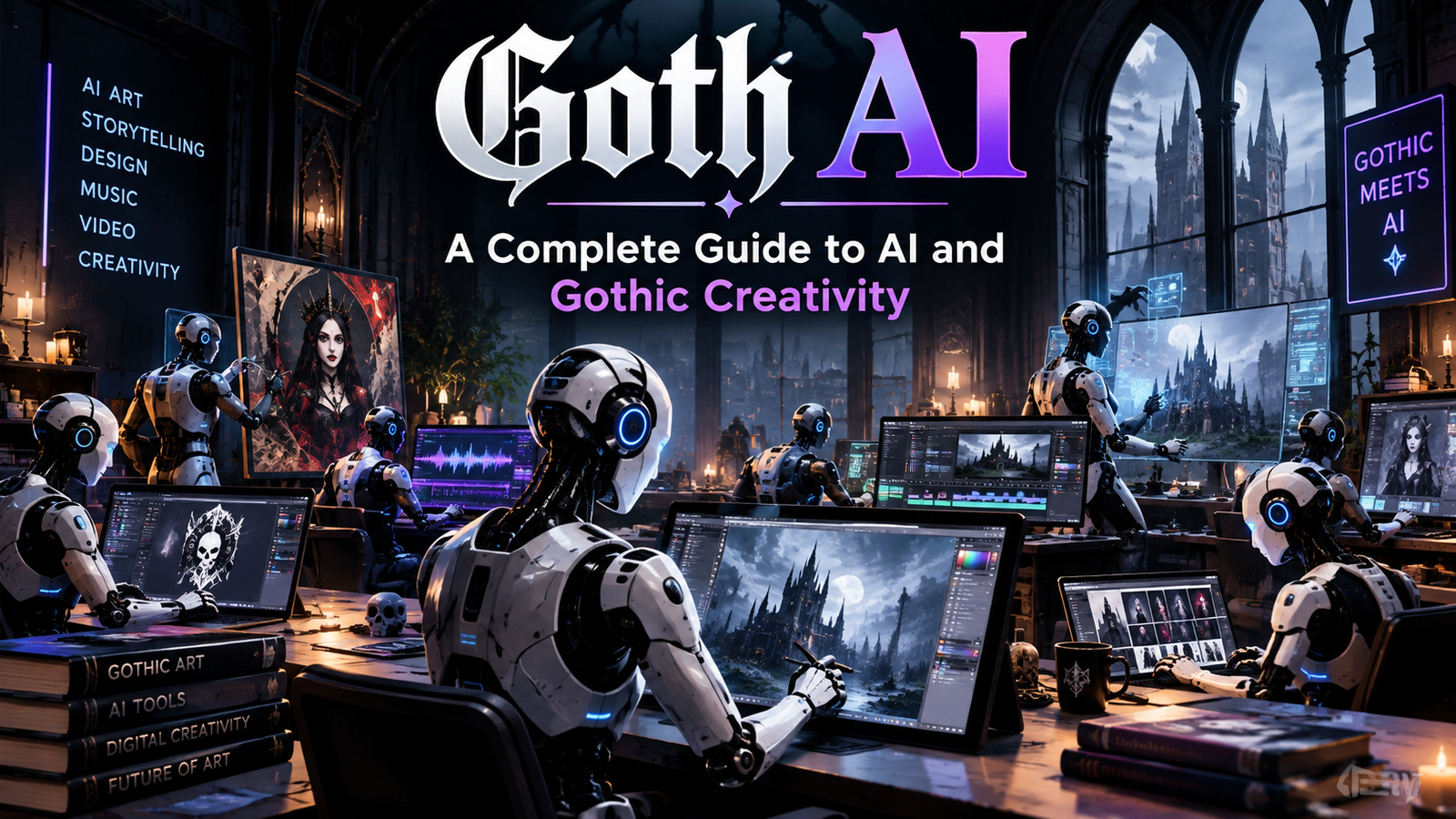

Goth AI is becoming an interesting part of the growing world of artificial intelligence and digital creativity. As AI tools become easier to use, people are finding new ways to combine technology with artistic styles that have strong visual identities. Gothic aesthetics are especially suitable for creative AI because they include dramatic architecture, mysterious environments, elegant fashion, atmospheric lighting, fantasy characters, and emotional storytelling.
The idea behind Goth AI is simple but powerful. It brings artificial intelligence into the world of gothic-inspired creativity, allowing users to turn ideas into images, characters, stories, designs, and digital concepts. Someone who enjoys gothic art can use AI to imagine an old castle surrounded by fog, a mysterious character standing under moonlight, an elegant dark fashion collection, or an entire fantasy world inspired by gothic architecture.
Goth AI is not limited to one application or one specific website. It can describe a broader creative approach in which AI technology is used to explore gothic themes and visual ideas. Depending on the tool, users may create images, develop characters, generate writing ideas, experiment with fashion concepts, or build visual references for larger creative projects.
As artificial intelligence continues to develop, the relationship between technology and creative expression is becoming more interesting. Goth AI demonstrates how a modern technology can be used to explore an artistic style that has existed in different forms for generations.
What Is Goth AI?
Goth AI refers to the use of artificial intelligence for creating, developing, or exploring content inspired by gothic aesthetics. This can include AI-generated artwork, gothic characters, dark fantasy environments, fashion concepts, stories, architectural ideas, and atmospheric digital scenes.
The word gothic can represent many different things depending on the context. It may refer to gothic architecture, gothic fashion, gothic literature, dark fantasy, alternative culture, or a general preference for mysterious and dramatic visual styles. Goth AI brings these creative elements into AI-assisted workflows.
For example, a user could describe an ancient gothic mansion with tall windows, stone walls, candlelit rooms, mist outside, and a full moon in the background. An AI image tool can use that description to produce a visual interpretation of the idea.
Another person might use Goth AI for a fictional character. They could describe the character’s clothing, personality, environment, age, hairstyle, lighting, and overall mood. The AI can then help visualize the concept.
This makes Goth AI particularly useful for people who have creative ideas but may not have advanced traditional art or design skills.
Why Is Goth AI Becoming Popular?
The popularity of Goth AI is connected to the rapid development of generative artificial intelligence. Modern AI systems can understand detailed written instructions and transform them into different forms of creative content.
Gothic aesthetics work especially well with generative technology because they contain strong visual characteristics. Dark backgrounds, dramatic lighting, historical buildings, elaborate clothing, foggy landscapes, mysterious characters, and fantasy environments can all be described in detail.
Another reason for the growing interest is personalization. Instead of searching for an existing gothic image that approximately matches an idea, users can describe what they actually want.
Someone might want a gothic city at night with Victorian architecture and modern neon signs. Another person might want a fantasy castle located in a snowy mountain range. AI can help explore both concepts.
Social media has also played an important role in the popularity of AI-generated gothic artwork. Creative images can attract attention because they combine familiar aesthetics with unusual ideas. This encourages artists, designers, writers, and hobbyists to experiment further.
How Does Goth AI Work?
The basic process behind Goth AI is similar to other generative AI systems. A user provides instructions, commonly called a prompt, describing the desired result. The AI system processes the instructions and generates an output based on its underlying model.
For image generation, the prompt may contain information about the subject, environment, lighting, mood, composition, clothing, architecture, and artistic direction.
For writing, the instructions might describe a gothic story, character, setting, or emotional tone.
The quality of the output depends partly on the AI system and partly on how clearly the user communicates the idea. A detailed prompt usually provides more creative direction than a very short instruction.
However, AI does not understand creative ideas in exactly the same way a human artist does. It interprets patterns and instructions based on its training and system design. This is why the output may sometimes contain unexpected details.
The best approach is usually to treat AI as a creative assistant. The user provides the vision, reviews the result, and makes decisions about what should be changed or improved.
Goth AI for Image Generation
AI image generation is one of the most popular applications of Goth AI. It allows users to create visual concepts without manually drawing every element.
A gothic image can be created around almost any subject. A user might choose a person, castle, forest, city, library, room, garden, or fantasy creature as the central subject.
The atmosphere can then be developed through additional details. Moonlight can create a mysterious feeling, while candlelight can make an old interior feel warm and dramatic. Fog can add depth to an outdoor scene, while rain can create a darker and more emotional atmosphere.
Composition also matters. A close portrait can focus attention on a character, while a wide architectural scene can emphasize the scale of a gothic environment.
Goth AI makes it possible to experiment with these ideas quickly. A user can create one version, change a few details, and generate another version with a different atmosphere.
How to Create Better Goth AI Prompts
A strong prompt can make a significant difference when using an AI image generator.
Instead of writing a very short phrase such as “gothic woman,” a user can describe the subject in greater detail. The prompt might explain the clothing, hairstyle, setting, lighting, mood, camera perspective, and architectural background.
For example, a creative prompt could describe an elegant fictional character wearing dark Victorian-inspired clothing while standing inside an old gothic library at night. The scene could include tall bookshelves, antique furniture, candles, soft moonlight, subtle fog, and dramatic shadows.
This gives the AI more information to work with.
Users should also avoid adding unnecessary details that conflict with each other. If one part of the prompt asks for a bright summer environment and another part demands a dark midnight atmosphere, the system may produce an inconsistent result.
Experimentation is important. A prompt that works well for one AI tool may produce a different result in another tool.
Goth AI and Gothic Characters
Character creation is another useful application of Goth AI.
Writers, game developers, digital artists, and hobbyists can use AI to explore character concepts before creating a final design. A gothic character can be developed around personality, fashion, environment, history, and visual appearance.
A character might be an elegant fictional scholar living in an ancient library. Another could be a mysterious traveler moving through a fog-covered city. A fantasy character could live inside an enormous gothic castle surrounded by mountains.
The important part is that the character should have a purpose within the creative project.
AI can help with visual brainstorming, but the creator should decide what the character represents and how the character fits into the story.
This approach makes character generation more meaningful than simply asking for a random dark-looking person.
Goth AI and Gothic Fashion
Gothic fashion provides another area where artificial intelligence can support creativity.
Gothic fashion can include dark clothing, dramatic silhouettes, vintage influences, unusual accessories, layered materials, and distinctive styling. AI can help designers explore combinations before developing physical clothing.
A designer could imagine a modern gothic collection inspired by Victorian architecture. Another concept could combine gothic streetwear with futuristic materials and minimalist accessories.
AI-generated fashion concepts can be useful during the brainstorming stage. They can help designers visualize possibilities and decide which directions deserve further development.
However, a generated image should not automatically be treated as a practical clothing design. Real clothing requires consideration of fabric, construction, comfort, movement, sizing, production, and cost.
Human design expertise remains essential.
Goth AI and Gothic Architecture
Architecture is one of the strongest visual areas for Goth AI.
Gothic architecture is known for dramatic vertical structures, pointed arches, detailed stonework, large windows, towers, decorative elements, and historical atmosphere. These characteristics can provide AI systems with rich creative instructions.
Users can create fictional castles, churches, libraries, mansions, underground halls, bridges, and entire cities inspired by gothic architecture.
AI can also combine historical influences with modern design. A creator might imagine a contemporary building that uses gothic arches, dark stone, large glass surfaces, and modern lighting.
These experiments can be useful for concept art, game development, creative writing, interior design inspiration, and visual storytelling.
When historical accuracy is important, however, AI-generated architecture should be checked against reliable sources rather than treated as an exact historical representation.
Goth AI for Digital Art
Digital artists can use Goth AI as a source of inspiration during the creative process.
An artist may have a general idea but struggle to decide how the final composition should look. AI can provide several possible interpretations of the same concept.
For example, an artist could explore different versions of a gothic forest. One version might emphasize moonlight, another might focus on fog, and another might use a dramatic sunset.
The artist can then study these variations and develop a personal composition.
This is one of the more useful ways to approach AI-assisted art because the technology becomes part of the brainstorming process rather than the entire creative process.
Human creativity remains important because the artist decides which elements are valuable and how the final work should communicate an idea.
Goth AI for Storytelling
Goth AI can also support writers who are interested in gothic fiction and dark fantasy.
A writer can use AI to brainstorm settings, characters, plot possibilities, dialogue ideas, and atmospheric descriptions.
A gothic story might take place inside an abandoned mansion, an old city, a mysterious forest, a forgotten library, or a fictional kingdom surrounded by mountains.
AI can help generate early ideas, but writers should develop the final story in their own voice. Human editing is particularly important for maintaining originality, emotional depth, consistency, and a natural writing style.
The strongest use of AI in storytelling is often collaborative. The writer provides the main creative direction while AI helps explore possibilities.
Goth AI for Photography Inspiration
Photography is another area where Goth AI can provide useful creative references.
A photographer preparing a gothic-themed photoshoot can use AI to explore ideas for lighting, clothing, poses, backgrounds, and composition.
For example, a photographer might create a concept featuring a model inside an old building with dramatic window light and vintage clothing. The generated concept can help communicate the intended mood before the actual photoshoot.
The final photograph can then be produced using real people, locations, lighting equipment, and photography techniques.
In this way, Goth AI can function as a visual planning tool rather than a replacement for photography.
Goth AI for Social Media Creators
Social media creators can also use Goth AI when developing themed content.
A creator focusing on gothic aesthetics may need backgrounds, character concepts, visual ideas, captions, or creative themes. AI can help generate early concepts that can later be edited and adapted.
Consistency is important for social media. If an account has a recognizable gothic identity, the visual style should remain reasonably consistent across posts.
Creators should also review AI-generated content carefully before publishing it. Strange details, inaccurate objects, distorted elements, or unintended similarities can sometimes appear.
The creator remains responsible for the final content.
Practical Ways to Use Goth AI
Goth AI can be used for many different creative purposes. A beginner might start by generating a simple gothic environment and then gradually experiment with characters, architecture, fashion, and storytelling.
A content creator could use it to develop visual concepts for articles or social media posts.
A writer could use it to imagine fictional locations and characters.
A game developer could explore early environment concepts.
A fashion designer could experiment with visual combinations.
A photographer could develop mood boards and lighting references.
An artist could use it to explore compositions and creative directions.
The most practical approach is to begin with a clear goal. Instead of generating random images without a purpose, decide what the content is supposed to communicate.
Benefits of Goth AI
One of the biggest benefits of Goth AI is accessibility. People without advanced artistic training can experiment with creative ideas through natural language instructions.
Speed is another advantage. AI can produce early concepts much faster than many traditional creative workflows.
Flexibility is also valuable. Users can change individual parts of an idea and explore multiple variations without rebuilding the entire concept manually.
Goth AI can also help with brainstorming. An unexpected AI-generated result may inspire a completely different idea that the user had not considered before.
The technology can therefore be valuable even when the original generated output is not used directly.
Limitations of Goth AI
Goth AI also has limitations that users should understand.
Generated images can contain errors. Hands, facial features, text, architecture, objects, and proportions may sometimes appear unnatural or inconsistent.
AI can also misunderstand prompts. A detailed description does not guarantee a perfect result.
Another limitation is originality and ownership. The legal treatment of AI-generated material can depend on the tool, the type of content, how much human creativity is involved, and the laws that apply to a particular situation.
Users planning commercial projects should always review the relevant platform terms and applicable laws.
AI-generated historical scenes can also contain inaccurate details. If the purpose is education or historical research, real sources should be consulted.
For general background about artificial intelligence and its broader applications, readers can explore IBM’s artificial intelligence overview.
Is Goth AI Safe to Use?
Using AI for ordinary creative purposes can be a safe and useful experience when users follow responsible practices.
Users should avoid creating deceptive content intended to mislead people. They should also be careful when using real people’s identities, photographs, or personal information.
For fictional gothic characters and imaginary environments, the risks are generally easier to manage because the content is clearly creative.
Creators should also check the rules of the AI service they use. Different platforms may have different policies regarding generated content, commercial use, privacy, and prohibited material.
Responsible use is important because AI technology is powerful and can be used in many different ways.
Goth AI and Human Creativity
The rise of AI does not mean human creativity has become unnecessary.
In fact, creative judgment may become even more important.
An AI system can generate many possibilities, but the human creator decides which possibility has meaning. The creator chooses the subject, purpose, emotional direction, and final presentation.
This is especially relevant to gothic art because atmosphere and emotion are central to the style.
A generated image may contain a dark castle, fog, and moonlight, but the creator decides whether the scene feels mysterious, romantic, frightening, nostalgic, or peaceful.
That human interpretation gives creative work its identity.
How Beginners Can Start With Goth AI
Beginners should start with simple ideas instead of trying to control every possible detail immediately.
A good starting point is one subject, one environment, and one atmosphere.
For example, a beginner could start with a gothic castle at night. After understanding how the AI responds, they could experiment with fog, lighting, architecture, weather, camera perspective, and character placement.
Keeping notes about successful prompts can also be useful. If a particular description produces an interesting result, the user can modify it rather than starting from zero.
Over time, users become better at communicating creative ideas through prompts.
Goth AI and the Future of Creative Technology
The future of Goth AI could become increasingly interactive.
AI systems are improving in their ability to understand complex instructions and work across different forms of media. Future creative tools may provide greater control over characters, environments, animation, sound, and interactive worlds.
This could allow creators to develop complete gothic experiences rather than individual images.
A future project might combine AI-generated architecture, characters, music, storytelling, and interactive environments into one digital world.
Virtual reality and gaming could make these experiences even more immersive.
Although it is difficult to predict exactly how the technology will develop, the broader trend suggests that AI will continue to provide new creative possibilities.
Read More About : blog whatutalkingboutwillis
Frequently Asked Questions About Goth AI
What does Goth AI mean?
Goth AI generally means using artificial intelligence to create or explore gothic-inspired content. This can include artwork, characters, stories, fashion concepts, architecture, environments, and digital experiences.
Can Goth AI generate gothic images?
Yes. AI image-generation systems can create gothic-inspired images when users provide suitable prompts describing the subject, atmosphere, lighting, environment, and artistic direction.
Is Goth AI a specific website?
Not necessarily. Goth AI is a broad term rather than a universal name for one specific platform. Different AI tools can be used to create gothic-inspired content.
Can beginners use Goth AI?
Yes. Beginners can use AI creative tools by starting with simple prompts and gradually learning how to describe subjects, environments, lighting, moods, and other visual elements.
Can Goth AI be used for storytelling?
Yes. AI can help writers brainstorm gothic characters, settings, plot ideas, descriptions, and other creative elements. The final story should be reviewed and developed by the writer.
Can Goth AI help with gothic fashion?
Yes. AI can be used to explore gothic clothing concepts, styling ideas, accessories, colors, silhouettes, and visual themes. Practical clothing design still requires human expertise.
Is AI-generated gothic artwork always accurate?
No. AI-generated content can contain visual or factual mistakes. Historical architecture, clothing, objects, and other details should be checked when accuracy is important.
Can Goth AI replace a professional artist?
Goth AI can assist with brainstorming and visual experimentation, but it does not completely replace the creative judgment, experience, technical skills, and personal expression of a professional artist.
Can Goth AI be used for commercial projects?
Potentially, but users should check the terms and licensing rules of the specific AI platform they use. Commercial use can involve additional legal and ownership considerations.
What makes a good Goth AI prompt?
A good prompt clearly describes the subject, environment, mood, lighting, composition, clothing, architectural details, and other important elements. Clear instructions usually provide better creative direction.
Final Thoughts
Goth AI represents an exciting meeting point between artificial intelligence and gothic creativity. It provides new ways to explore visual art, fashion, architecture, storytelling, photography, character design, and digital creativity.
The appeal of Goth AI comes from its flexibility. A person can start with a simple idea and gradually develop it into something much more detailed. A gothic castle can become an entire fictional world. A character concept can become the foundation of a story. A fashion idea can inspire a real design. A digital image can become the starting point for a photography project.
At the same time, AI should be approached realistically. Generated content can contain mistakes, and users should review their work carefully. Copyright, licensing, privacy, and platform rules should also be considered when content is published or used commercially.
The most effective approach is to combine AI capabilities with human imagination. Artificial intelligence can help generate possibilities, but people provide the purpose, emotion, judgment, and creative direction.
As AI technology continues to evolve, Goth AI is likely to remain an interesting area for artists, writers, designers, photographers, gamers, fashion enthusiasts, and anyone who enjoys dark and atmospheric creative styles. Its greatest value is not simply the ability to generate something visually dark. It is the ability to transform an imaginative idea into a visual or creative starting point.
For creators who enjoy mystery, atmosphere, dramatic design, gothic architecture, alternative fashion, dark fantasy, or emotional storytelling, Goth AI offers a modern way to explore those interests. With thoughtful prompts, responsible use, careful editing, and genuine human creativity, AI can become a useful part of the creative process while still allowing the creator’s own vision to remain at the center.