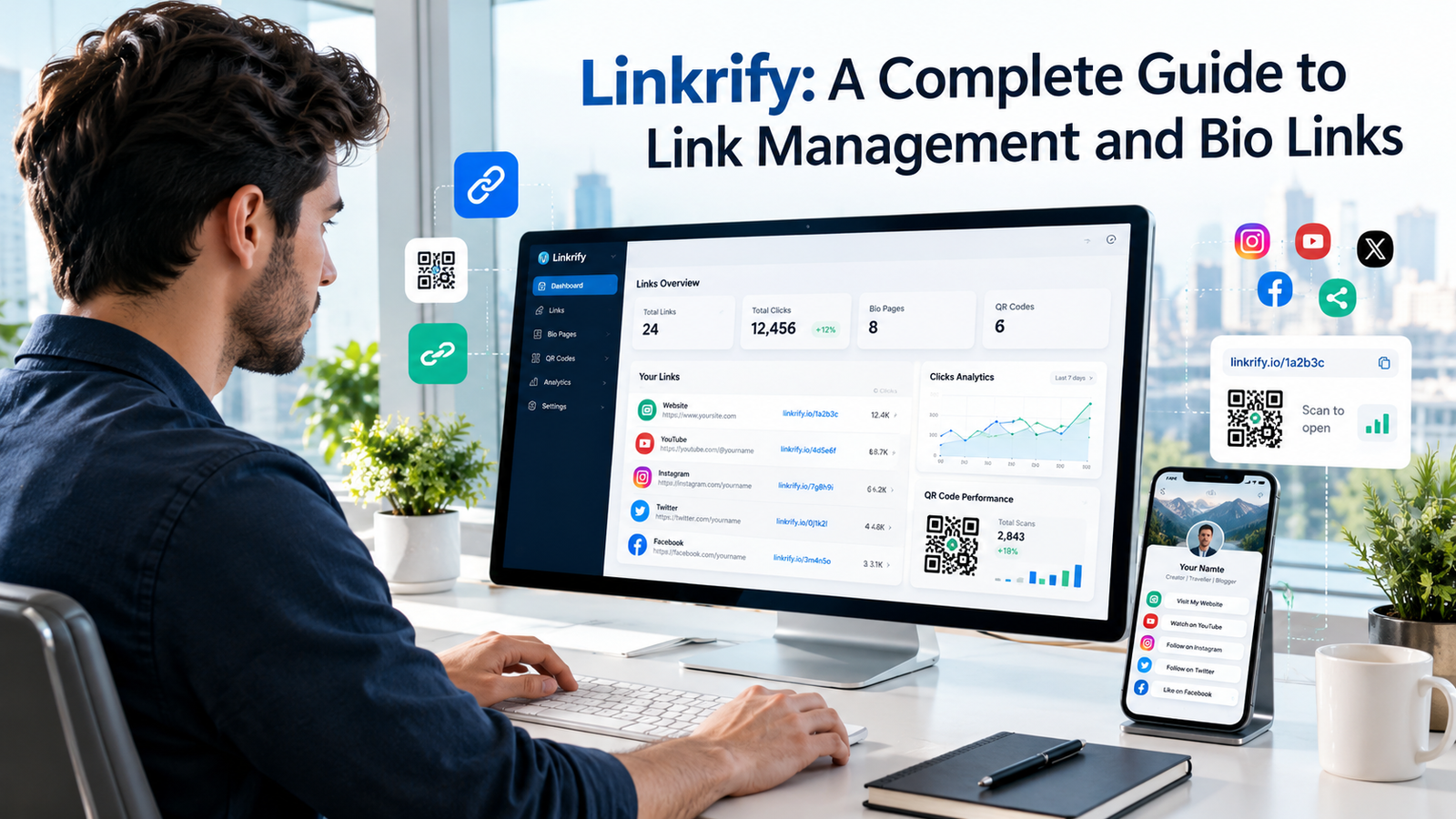

In today’s digital world, people share links everywhere. A creator may have an Instagram profile, a YouTube channel, a personal website, an online store, social media accounts, affiliate pages, and several other destinations that they want their audience to visit. The problem is that sharing all of these links separately can make a profile look crowded and difficult to manage. This is where Linkrify can become useful.
Linkrify is an online link management and bio-link platform designed to help creators, marketers, businesses, bloggers, and other internet users organize multiple destinations in one convenient place. Instead of asking visitors to remember several URLs, users can create a central page that brings different links together. The platform also goes beyond basic bio pages by offering tools for shortened URLs, QR codes, analytics, file sharing, event links, and other digital activities.
The idea behind Linkrify is simple. People already have many places where they publish or promote content, but their audience usually needs one easy starting point. A well-designed krifLiny page can act as that starting point. It can contain social profiles, websites, products, videos, articles, contact information, campaigns, and other important destinations.
For creators, this can make social media profiles more useful. For businesses, it can provide a simple way to organize marketing links. For bloggers and website owners, it can make sharing content easier. For marketers, analytics can provide useful information about how audiences interact with shared links.
What Is Linkrify?
Linkrify is a digital platform focused on organizing, sharing, shortening, and tracking online links. Its official platform combines several link-related features in one dashboard rather than requiring users to depend on separate services for every task.
The central feature is the ability to create a customizable bio-link page. This page can work as a small digital hub where visitors find multiple links connected to one person, brand, creator, or business. Instead of placing several URLs directly inside a social media profile, a user can share one Linkrify URL that leads visitors to the complete collection.
Linkrify also provides shortened links. Long URLs can be difficult to remember, unattractive in social posts, and inconvenient when shared through messages or printed materials. A shortened link provides a cleaner alternative while potentially making tracking and campaign management easier.
Another important part of the platform is analytics. Linkrify states that its analytics can provide information such as countries, cities, devices, operating systems, browsers, languages, referrers, and UTM-related data. This type of information can help users understand where their traffic is coming from and how people interact with their shared links.
Why Linkrify Is Becoming Useful for Online Users
The modern internet is highly fragmented. A single person can maintain profiles on several social networks while also managing a website, newsletter, online store, portfolio, video channel, and community. Each destination may have a different URL.
This creates a simple but important problem. If a visitor wants to explore everything a creator offers, they need an easy way to move from one destination to another.
Linkrify addresses this problem by bringing multiple destinations together. A creator can create a central page and then use the same page URL across social profiles, email signatures, business cards, websites, and other promotional channels.
The value is not only convenience. A centralized page can also create a more professional online presence. Instead of presenting visitors with a collection of unrelated URLs, a creator can organize the destinations under a consistent design.
For businesses, this can be especially helpful when campaigns change frequently. A business may promote a new product one week and a different service the next. Rather than changing every social profile individually, the business can update the central link page and keep the same primary URL.
Linkrify for Social Media Creators
Social media creators are among the users who can benefit most from a bio-link platform. Instagram, TikTok, YouTube, X, LinkedIn, and other platforms can have different limitations around external links. A single link in a profile can therefore become extremely valuable.
A creator using Linkrify can place several destinations behind that one profile link. For example, a photography creator might connect a portfolio, YouTube channel, booking page, latest project, contact page, and social profiles.
The creator does not have to constantly explain where each destination can be found. Instead, followers can open the central page and choose the destination that interests them.
This also creates a better experience for mobile users. Since a large amount of social media traffic comes from smartphones, having a simple mobile-friendly destination can make navigation easier.
A good bio page should not overwhelm visitors. The best approach is to place the most important destination near the top and keep the overall design clean. Linkrify offers customization options that can help users create a page that matches their personal or brand identity.
Linkrify for Small Businesses
Small businesses often need to promote multiple online destinations without investing in complicated technology. A restaurant may have a website, menu, reservation page, social media accounts, delivery service, customer support channel, and location information.
An online store may have product pages, customer support, special offers, social profiles, and seasonal campaigns.
Instead of promoting each URL separately, a business can use one central link page. This can simplify marketing across social media, printed materials, email communication, and messaging platforms.
The professional appearance of a centralized link page can also help a small business build consistency. Branding elements such as colors, images, buttons, and page structure can make the destination feel connected to the business rather than looking like a random collection of URLs.
This does not replace a complete business website. Instead, it can work as a supporting digital hub that directs visitors toward the pages that matter most.
Linkrify and Short Links
Long URLs are often inconvenient. A URL can become particularly lengthy when it contains tracking parameters, campaign information, product identifiers, or complicated website paths.
Linkrify provides a URL shortening feature designed to turn long addresses into shorter and more manageable links. According to the platform, its short-link system supports features such as scheduling, expiration limits, country targeting, device targeting, language targeting, A/B rotation, password protection, deep links, and advanced URL management.
These features can be useful for digital marketing campaigns.
Imagine a business promoting a seasonal sale. Instead of publishing a complicated URL across different platforms, the business can create a cleaner short link. If the campaign has a specific expiration date, scheduling features can also make the process easier.
Short links can also be helpful when URLs are shared verbally, placed inside advertisements, printed on promotional material, or used in social media posts.
However, users should always make sure that shortened links lead to trustworthy destinations. A short URL hides the original destination, so transparency and responsible use are important.
Linkrify Analytics and Link Tracking
One of the biggest advantages of professional link management is the ability to understand audience behavior.
Simply sharing a link does not tell you whether people are clicking it. Analytics can provide a clearer picture of what happens after a link is published.
Linkrify provides analytics related to traffic and audience interactions. The platform states that users can view information involving countries, cities, devices, operating systems, browsers, languages, referrers, and UTM parameters.
This information can be useful for marketers and creators because it can show which channels are producing engagement.
For example, a creator may share the same destination on Instagram, YouTube, and a newsletter. Tracking information can help reveal which source is generating more visits.
A business can use similar information to understand whether a campaign is reaching the intended audience. If most visitors are coming from mobile devices, the landing experience should be optimized for mobile users.
Analytics should not be treated as a guarantee of sales or conversions. Instead, analytics are most useful when they are combined with good content, clear calls to action, relevant offers, and a well-designed landing experience.
Linkrify QR Code Features
QR codes have become common in restaurants, retail stores, events, packaging, advertisements, business cards, and promotional campaigns.
A QR code provides a bridge between physical and digital marketing. Someone can scan a code using a smartphone and immediately access a website, contact card, location, Wi-Fi information, calendar event, or another destination.
Linkrify includes a QR code generator with customizable options. Its official platform describes support for different templates, colors, gradients, logos, backgrounds, frames, and QR-related use cases such as vCards, Wi-Fi, calendars, and locations.
This makes QR codes more useful than simply creating a basic black-and-white square.
For example, a freelancer could place a QR code on a business card that leads to a Linkrify page containing a portfolio, email address, social profiles, and booking information.
A restaurant could use a QR code to direct customers toward its menu or digital ordering page.
A conference organizer could connect a QR code to an event-related page.
The combination of QR codes and link management can make offline marketing more measurable and easier to update.
Linkrify for Digital Marketers
Digital marketers often work with multiple campaigns at the same time. Each campaign can have its own landing page, audience, traffic source, and performance goals.
Managing these URLs manually can quickly become confusing. A link management platform can provide a more centralized approach.
Linkrify offers features designed for link organization and campaign tracking. Its platform includes UTM support and tracking-pixel integrations, allowing marketers to connect links with broader measurement strategies.
For marketers, the important point is not simply having many tools. The real benefit comes from organizing them into a practical workflow.
A marketer might create a campaign URL, add tracking parameters, publish it across social media, monitor traffic, and later update or replace the destination. This can reduce the need to repeatedly edit every promotional location.
Link management can become particularly valuable when campaigns involve multiple countries, devices, or audience groups.
Linkrify for Bloggers and Website Owners
Bloggers can use Linkrify as an additional distribution channel for their content.
A blogger may have dozens or hundreds of articles on a website. However, social profiles usually provide limited space for sharing those articles individually.
A Linkrify page can serve as a curated collection of important content. The blogger can highlight the latest article, most popular guide, newsletter, social profile, contact page, and other destinations.
This approach can also make profile visitors more likely to discover older content that might otherwise remain buried inside the website.
For content creators who publish frequently, keeping the central page updated can create a simple content-distribution routine.
At the same time, bloggers should remember that a bio-link page does not replace proper search engine optimization. The main website should still have useful content, strong internal linking, good technical performance, appropriate metadata, and valuable information for readers.
Linkrify for Freelancers and Professionals
Freelancers often need to present several aspects of their professional identity at once. A graphic designer may want to show a portfolio, LinkedIn profile, client testimonials, contact information, and project examples.
A developer may want to share GitHub, portfolio projects, resume, professional profile, and contact details.
A consultant may need to provide a booking page, services page, case studies, newsletter, and contact form.
Linkrify can act as a compact professional hub for these destinations.
The biggest advantage is simplicity. Instead of sending a separate message containing several URLs, a professional can share one central link.
This can also be useful in email signatures. Rather than filling the signature with many separate links, a single link can direct the recipient to a professional page containing the full set of resources.
Customization and Branding
A major reason users choose a link page platform is branding.
A generic page may technically work, but branding can make the experience feel more professional. Colors, typography, backgrounds, button styles, images, and content arrangement can all influence how visitors perceive a page.
Linkrify provides customization options for its bio pages, including custom colors and branding as well as ready-to-use components, themes, and templates depending on the available plan.
A good branded page should remain simple. Too many colors, animations, buttons, and unrelated destinations can make the page difficult to use.
The goal should be clarity. Visitors should understand who the page belongs to and what action they can take within a few seconds.
Is Linkrify Free?
Linkrify offers a free plan alongside paid options. The official platform currently lists a free tier with selected features and limits, while more advanced capabilities are available depending on the chosen plan.
The exact limits and available features can change over time, so anyone planning to use Linkrify for a business or professional project should check the current pricing information before making a decision.
A free plan can be useful for someone who wants to experiment with a bio page or basic link management without immediately committing to a subscription.
Users with more advanced requirements may need features related to analytics, custom domains, additional links, branding, scheduling, or other professional functionality.
How to Create a Linkrify Page
Creating a Linkrify page is generally straightforward. A new user begins by creating an account and accessing the platform dashboard. From there, the user can create a bio page and add the destinations they want visitors to see.
The next step is customization. Users can select an appropriate visual style, add branding elements, arrange buttons, and make the page fit their personal or business identity.
After adding the necessary destinations, the page can be published and the resulting URL can be shared across social profiles, websites, emails, and other channels.
The important thing is to keep the page focused. A page containing twenty unrelated links may not perform as well from a user-experience perspective as a carefully organized page containing the most relevant destinations.
How to Use Linkrify Effectively
Using a link management platform effectively requires more than simply adding links.
The first priority should be understanding the purpose of the page. A creator should know what visitors are expected to do after opening it. The page might be designed to generate newsletter subscriptions, promote products, increase video views, generate bookings, or simply provide access to important profiles.
Once the goal is clear, the most important link should receive appropriate visibility.
The page should also be updated regularly. Old promotions, expired offers, broken destinations, and outdated information can reduce trust.
Another important factor is mobile usability. Since many visitors will open a bio link from a smartphone, buttons should be easy to tap and text should remain readable on smaller screens.
A clean design is usually better than an overloaded design. Visitors should not have to search through a long page to find the main destination.
Linkrify and SEO
Linkrify can support online visibility, but it should not be viewed as a replacement for a complete SEO strategy.
Search engine optimization involves many factors, including content quality, relevance, technical performance, internal linking, user experience, authority, and search intent.
A Linkrify page can provide another organized destination for audiences, but the main website should remain the foundation of an SEO strategy.
For creators and businesses, the strongest approach is to use link management as part of a wider digital ecosystem. The central website can target search queries, social media can attract audiences, email can maintain relationships, and Linkrify can organize important destinations.
This creates a more connected online presence.
Privacy and Responsible Link Management
Privacy is an important consideration whenever analytics and tracking features are involved.
Linkrify provides analytics and tracking-related functionality, which means users should understand what information they are collecting and how it is being used. The platform states that its analytics are designed with compliance considerations including GDPR, CCPA, and PECR.
Businesses should still review their own privacy obligations and ensure that their websites, cookie notices, tracking systems, and marketing practices comply with applicable laws.
Responsible link management also means avoiding misleading destinations. A shortened URL should lead to the destination users reasonably expect. Transparent and trustworthy links are important for maintaining audience confidence.
Linkrify for Mobile Users
Mobile compatibility is essential for modern link pages.
Most social media profiles are accessed from smartphones, which means the experience after clicking a profile link can directly affect engagement.
A mobile-friendly Linkrify page can make it easier for visitors to navigate between different destinations without zooming, scrolling through complicated layouts, or dealing with difficult buttons.
Creators should always test their page on a smartphone before sharing it widely. The page should load smoothly, important links should be visible, and external destinations should work correctly.
A simple mobile experience can make a bigger difference than adding unnecessary visual effects.
Advantages of Using Linkrify
The main advantage of Linkrify is centralization. Instead of managing multiple separate sharing pages and link tools, users can bring several functions into one platform.
Another advantage is customization. A personalized page can better represent a creator or business than a generic collection of URLs.
Analytics can also provide valuable information. Understanding traffic sources, devices, locations, and referral activity can help users make better marketing decisions.
Short links provide another layer of convenience, while QR codes make it easier to connect physical marketing with digital destinations.
The platform can therefore be useful for a wide range of users, from individual creators to small businesses and digital marketers.
Potential Limitations of Linkrify
No platform is perfect for every user.
Someone who only needs a simple link in their social media bio may not require advanced analytics, QR codes, URL management, or other additional features.
Likewise, a large organization with complex marketing infrastructure may need specialized enterprise tools and deeper integrations.
The right choice depends on the user’s requirements, budget, workflow, and technical expectations.
Users should also understand the difference between a link management platform and a full website. Linkrify can organize and distribute destinations, but it does not automatically replace the need for a website, ecommerce platform, content management system, or dedicated marketing tools.
Linkrify vs Traditional Link Sharing
Traditional link sharing usually means sending URLs individually. This works when there are only one or two destinations.
The situation becomes different when someone has many online resources.
A centralized page provides a more organized experience. The visitor needs to remember only one main URL, while the owner can update the destinations behind that URL.
This flexibility is especially valuable for social media users because profiles often remain unchanged for long periods while campaigns and destinations change frequently.
Instead of constantly updating every promotional channel, the central destination can be maintained from one place.
Who Can Benefit Most From Linkrify?
Linkrify can be useful for content creators, influencers, bloggers, freelancers, entrepreneurs, marketers, small businesses, online educators, artists, musicians, consultants, and professionals who need to share multiple digital destinations.
A person does not need to be a technical expert to understand the basic concept. If someone already uses several online platforms and wants one central page for those destinations, a bio-link solution can make sense.
Its broader link-management features can also appeal to users who need more than a simple profile page.
Final Thoughts on Linkrify
Linkrify represents a practical approach to one of the most common problems in modern digital marketing: managing too many links across too many platforms.
Its combination of bio pages, short links, QR codes, analytics, file links, event links, and other link-management features makes it more than a basic profile-link service. The platform is designed to give creators and businesses a central place from which they can organize and distribute their digital destinations.
For someone who regularly shares content on social media, manages campaigns, promotes a business, or maintains several online profiles, having one organized link destination can save time and make the audience experience easier.
The most effective way to use Linkrify is to keep the page focused, branded, mobile-friendly, and regularly updated. Instead of adding every possible destination, users should prioritize the links that matter most to their audience.
Ultimately, Linkrify is useful because it simplifies the relationship between people and their online destinations. In an internet environment where creators and businesses are spread across multiple platforms, having one clear digital hub can make sharing, tracking, and managing links considerably easier.
Read More About : gimkit host